There is an old butsudan in our tatami room.
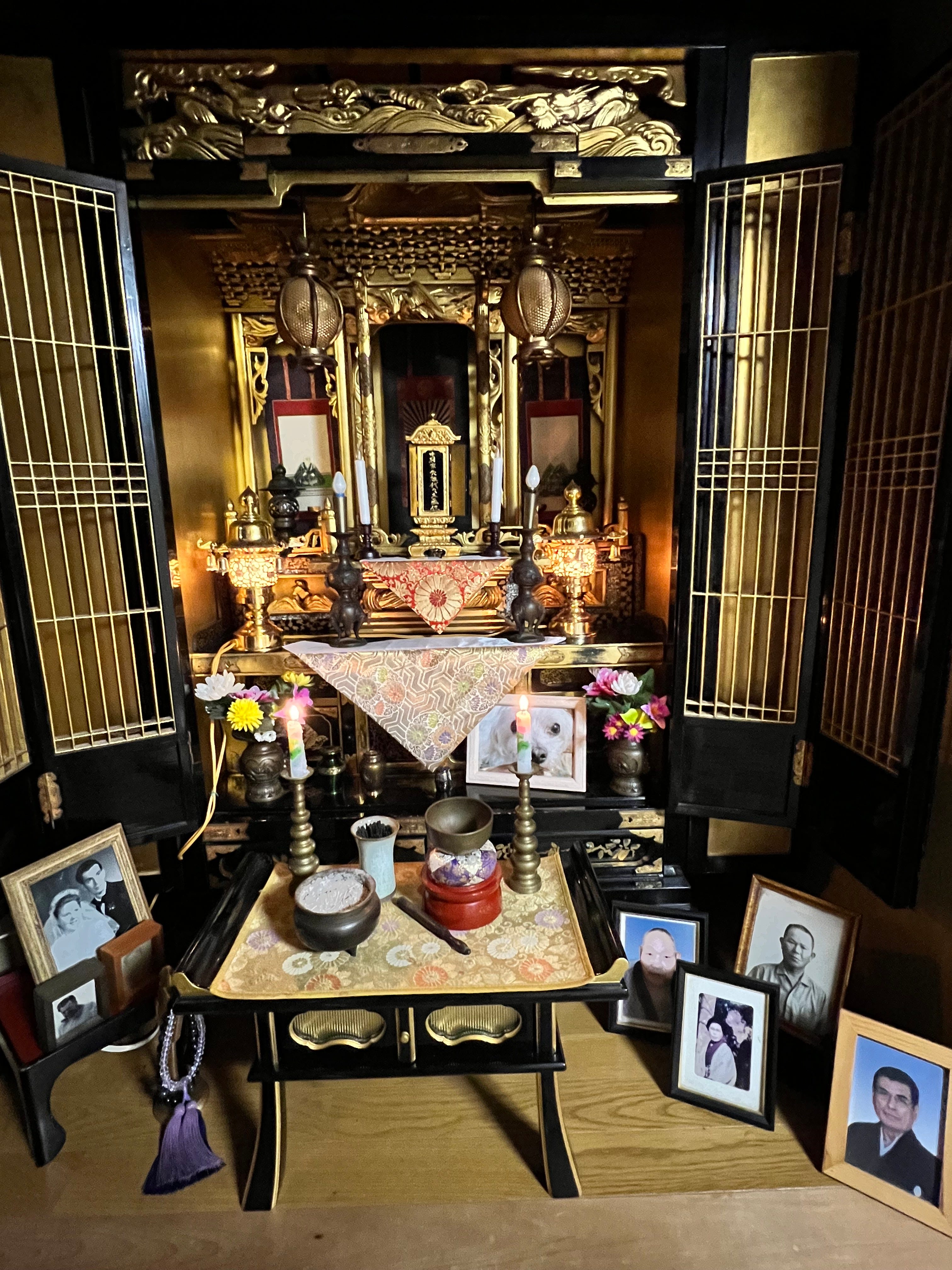
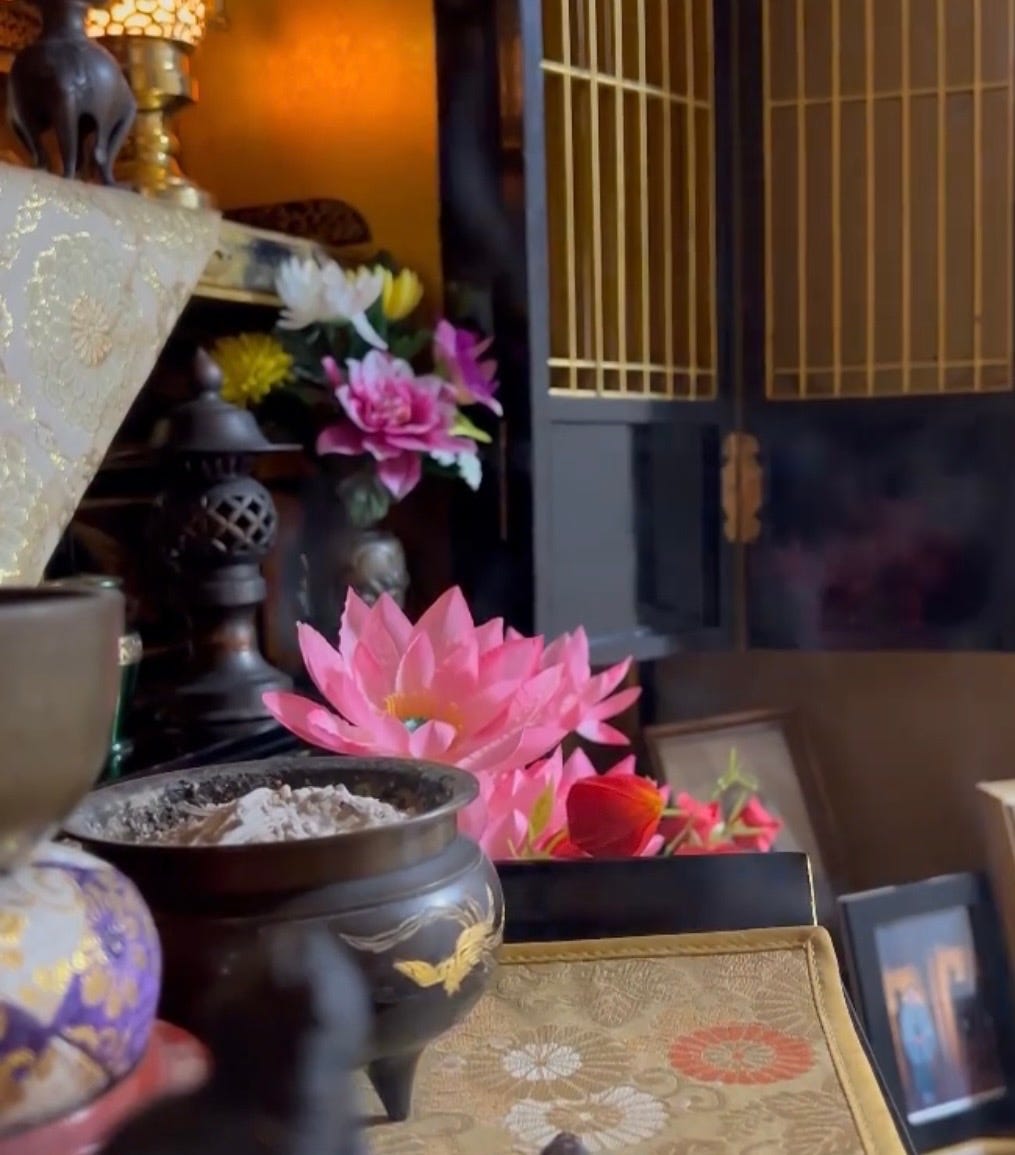
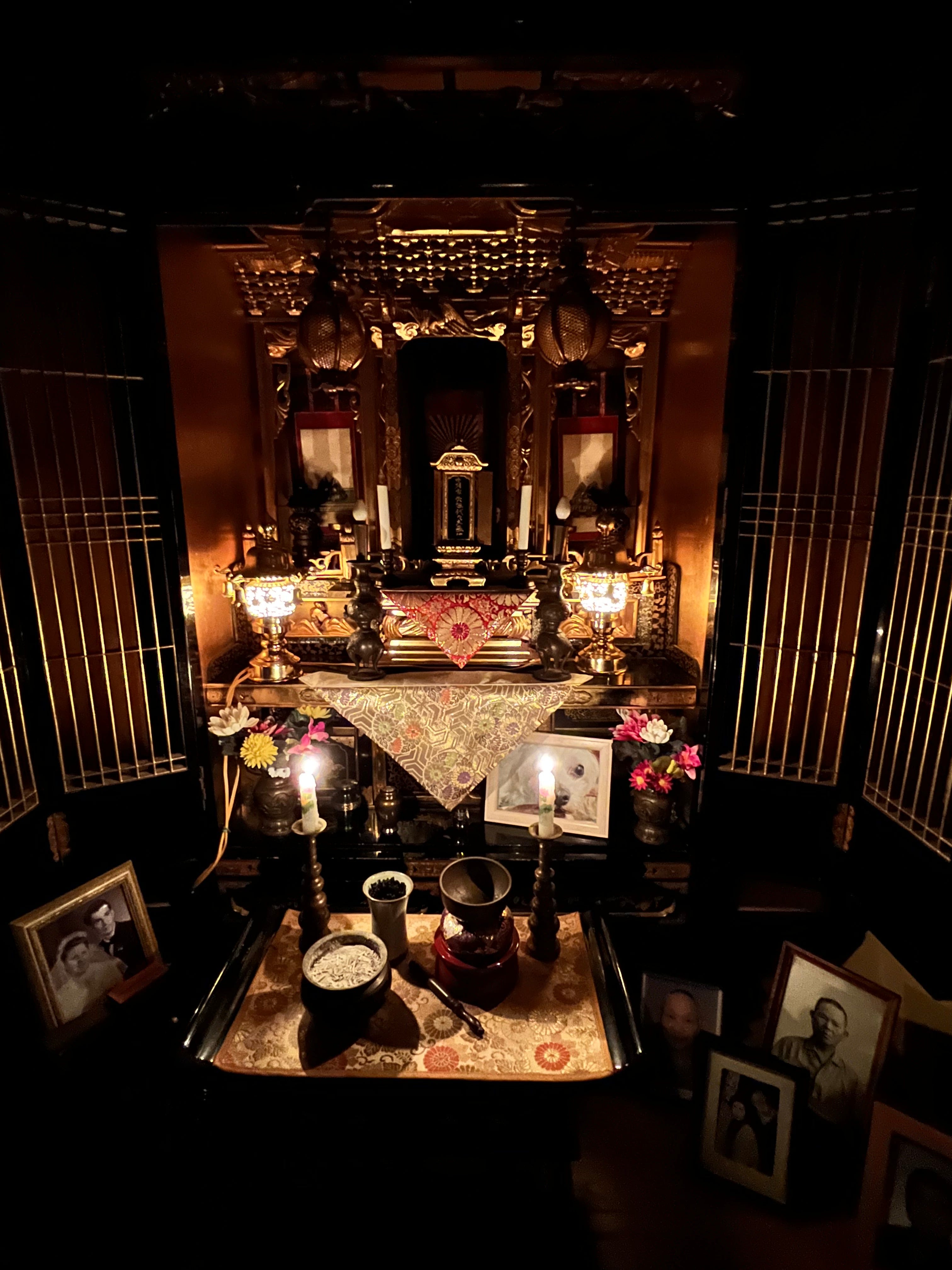
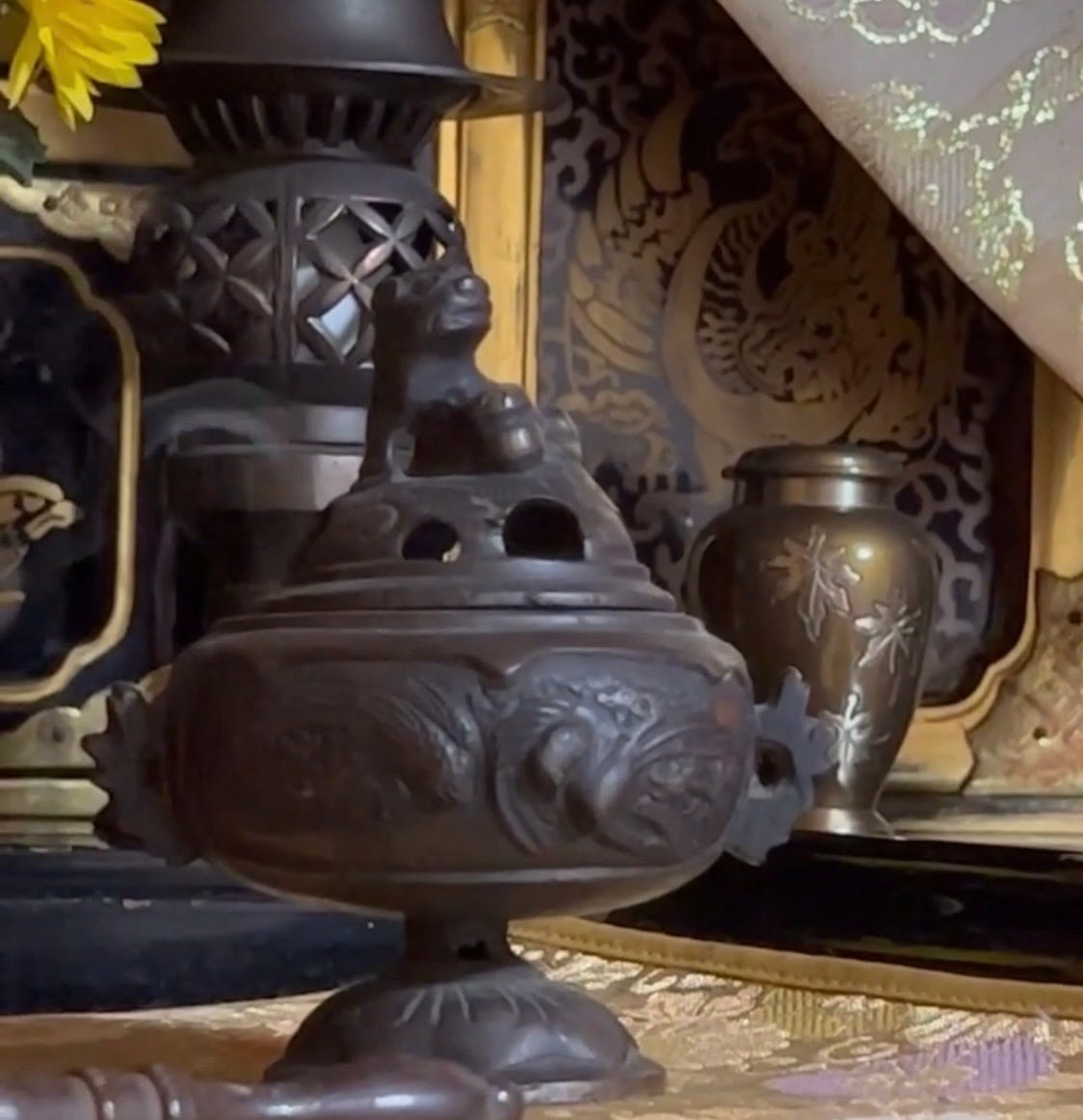
It is over one hundred years old. Black lacquer and gold, needs to be carefully carried by two or three men. Its doors are always open. Inside, the ihai tablet sit at the center. Candles, an incense burner and a small brass bell sit on a small black lacquer table. Fresh flowers adorn both sides. Photographs of the ancestors are arranged around the base, including our beloved dog.
I have spent years carefully dusting it and was always curious about the history of such an interesting object. I finally decided to do some research.
It is a traditional Kin Butsudan— 金仏壇 — a Golden Buddhist Altar adorned with black lacquer exterior and genuine gold leaf interior. Handcrafted by master craftsmen during the Taisho era, somewhere between 1912 and the early Showa years. The interior is built to represent the Pure Land — the Western Paradise of Jodo Shinshu Buddhism. The carved “ranma”at the top used for ventilation, the inner palace roof structure, the hanging lanterns all mirror the architecture of a Buddhist temple.
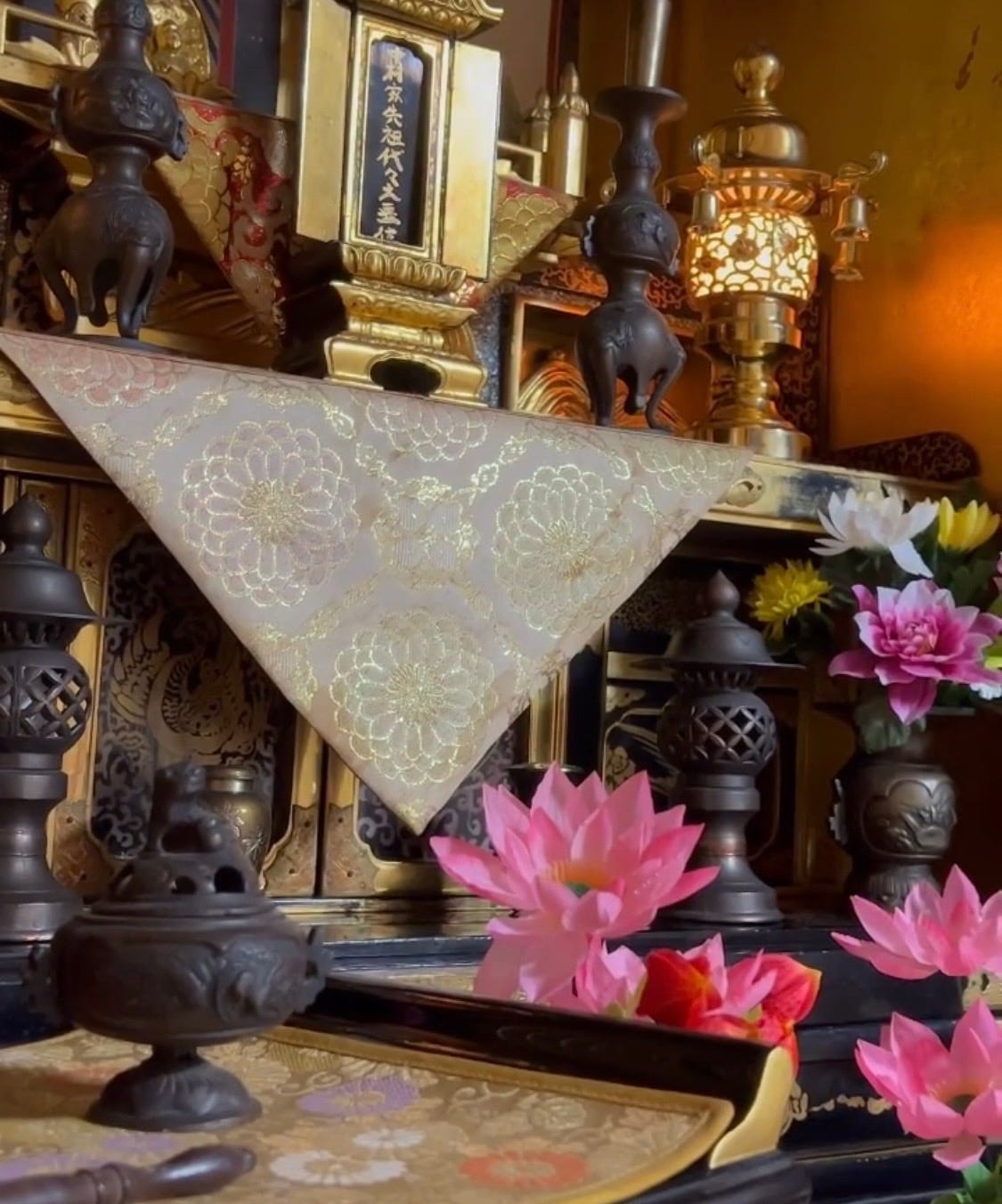
A Butsudan like this is a collaborative work — woodcarvers, lacquerers, gold-leaf specialists, each contributing their skill. The gold leaf has now aged to a warm tone. I used to think it was gold paint.
The honke — 本家 — is the main family household. It is the ancestral home, including the rice paddies, the vegetable gardens, and the family’s own section in the local cemetery. Generally, the eldest son took over the honke and with it the responsibility of caring for his parents as they aged. The honke remained the center “pillar” from which branch families called bunke, revolved around.
When ancestors passed on they did not leave the honke. The ancient belief is that the ancestors became the guardians of the household. They watched over the living from inside the butsudan. They protected the family and the land. Ancient Japanese believed that the ancestors were first and foremost the household’s guardian deities, kami, who watched over and protected the honke and all it encompassed.
Called Senzo-kuyo — ancestor veneration. More than just a religious custom. It is a reciprocal relationship. A daily relationship between the living and the dead.
I watched my mother in law offer incense, fresh water, the first scoop of rice from the morning pot. She did this every morning without fail. She chanted the Nenbutsu over and over while fulfilling the morning ritual- Na-man-da, na-man-da. A shortened version of the longer form.
In return, the ancestors watch over the household, protecting the land and the family.
This is what was literally believed and still believed by the elders. The spirits of the dead, through years of careful tending, gradually purify and rise. They become ujigami — ancestral guardian kami. They remain in the Butsudan.
The butsudan is not a memorial. It is a dwelling.
Only the honke kept a butsudan. The main house held the ancestors — literally. The branch families did not have an altar. The honke was not simply where the family lived. It was where the ancestors continued to reside.
During the Edo period this custom was formalized. Every family was registered to a temple. The honke was expected to maintain the altar, invite the priest, mark each ancestor’s death anniversary. The butsudan was not optional. It was the center of the household’s identity.
In my husband’s family a tragedy occurred. They lost the honke.
My husband’s grandfather was the mayor of his local area for many years. He was well respected. Not only as mayor but also as village chief. His estate was the honke — the rice paddies, the gardens, the family graves, the butsudan.
His oldest son — the chonan, the heir, the one the whole system was built around — lost it. He made a bad business deal. He used the honke as collateral. Unbelievable, I know. The honke was gone. My husband’s grandparents, the mayor and his wife, were forced to relocate. The only thing they could afford was a tiny 500 square foot dwelling. Everything was gone. They carried the butsudan with them and continued on the best they could.
The two younger brothers had their own families by then. They moved on. Grandmother passed away.
And when grandfather died, someone had to take the butsudan.
None of the brothers wanted it. I don’t know the details. My mother-in-law stepped forward. She carried the butsudan to her home and cared for it.
Eventually the butsudan came to us. To her oldest son. My husband.
So here it sits. In our tatami room. In a village in rural Fukuoka. The same altar that stood in the mayor’s honke. Survived everything. The bad deal, the lost house, the 500 square foot dwelling . Carried forward by a woman who was never supposed to be the one carrying it.
My husband says the old way of life in Japan is dying. And he doesn’t just mean the tradition of the butsudan.
He means the whole thing. The honke at the center of the village. The bunke families fanning out around it. Knowing your place in that web — as an identity. You knew where you came from. You knew who you were responsible to. You knew where you would be buried.
That world is almost gone.
It is estimated that there are nine million empty homes in Japan now. Many of them were someone’s honke once. The rice paddies now go unplanted. The graves are left untended. The fields gone to weeds.
People from outside Japan say they love Japanese culture. And I understand that. There is much to love.
But this is also Japanese culture. The empty honke standing forlorn in a tangle of weeds. Tatami rooms rotting away. Butsudan covered in dust and mice droppings. In some old homes the faded photos of the ancestors are still standing around the base with no one to care. No one to chant and pour water into the dust filled cups.
The oldest son who moved to Osaka and isn’t coming back. To him the honke is a burden to be sold off.
This is the new culture that pains my husband.
My husband and I tend the Butsudan now. He changes the water. He lights the incense. I cook the rice and dust.
Despite not being a Buddhist, I see this as being an invaluable piece of my husband’s heritage. It’s such a sad story so, we preserve what is left the best we can. We don’t know what will happen after we are gone.
The old life, held in a hundred-year-old golden cabinet in our tatami room. Are the ancestors still there? Did they depart when the honke was lost? I have no idea.
We just try to maintain what is left.


No comments:
Post a Comment